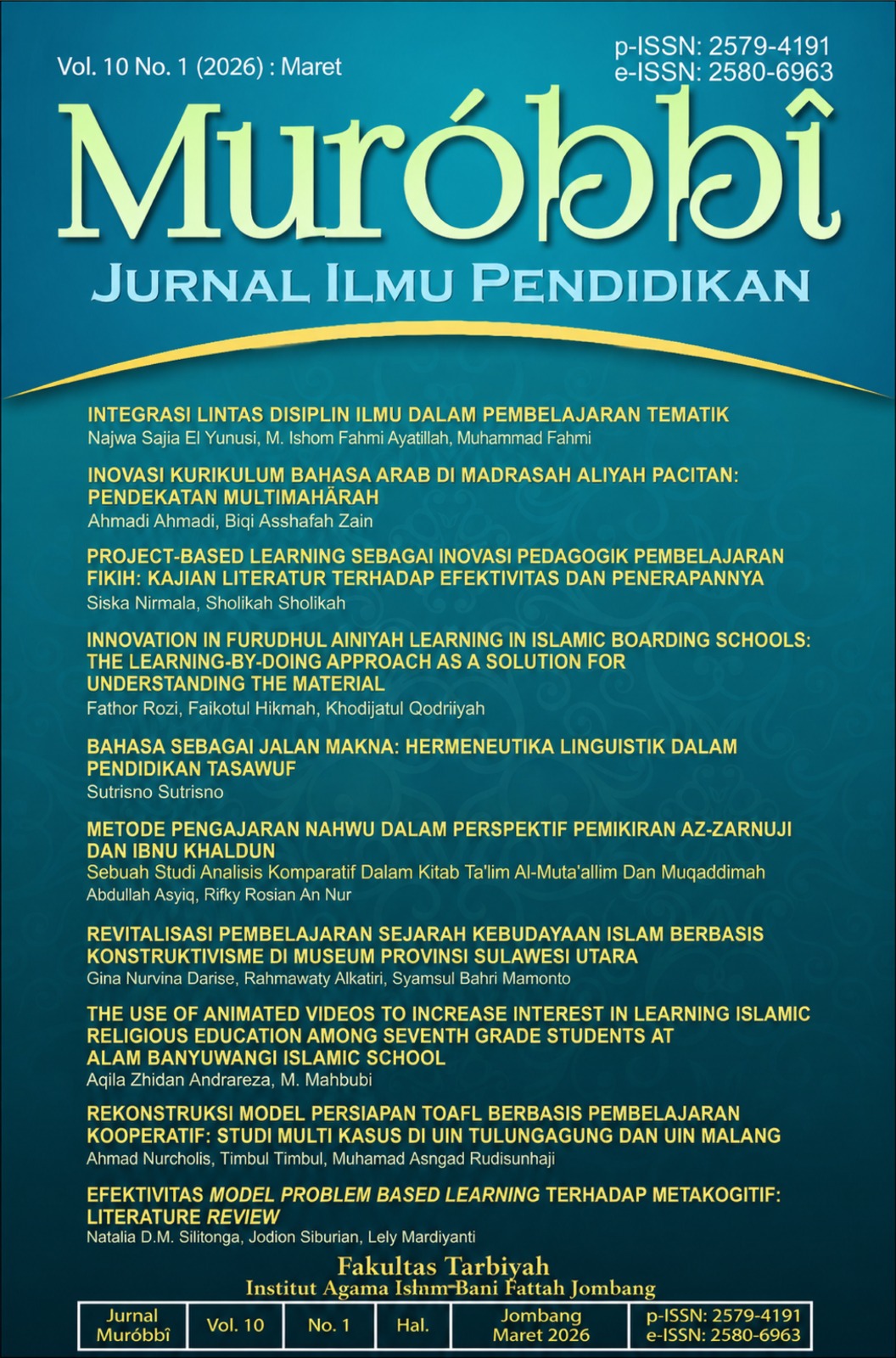
Rekonstruksi Model Persiapan TOAFL Berbasis Pembelajaran Kooperatif: Studi Multi Kasus di UIN Tulungagung dan UIN Malang
DOI:
https://doi.org/10.52431/murobbi.v10i1.4471Keywords:
Cooperative Learning, TOAFL, Social Interdependence Theory, Academic Arabic, Islamic Higher EducationAbstract
This study explores the reinvention of TOAFL preparation through the implementation of Cooperative Learning as an innovative pedagogical framework in Islamic higher education. Conducted as a multiple case study at UIN Sayyid Ali Rahmatullah Tulungagung and UIN Maulana Malik Ibrahim Malang, this research investigates how cooperative learning models reshape instructional practices, student engagement, and academic Arabic proficiency in high-stakes standardized testing contexts. Grounded in Social Interdependence Theory, the study examines how positive interdependence, individual accountability, promotive interaction, and collaborative skills are operationalized in TOAFL classrooms. Data were collected through in-depth interviews, classroom observations, and document analysis, involving lecturers, program coordinators, and students participating in TOAFL preparation programs. The findings reveal that cooperative learning not only enhances students’ linguistic competence including listening, structure, and reading skills but also fosters higher-order thinking, peer scaffolding, and adaptive learning strategies aligned with the demands of 21st-century education. Furthermore, the study demonstrates that collaborative learning environments contribute to increased motivation, reduced test anxiety, and stronger academic resilience. Institutional culture and lecturer innovation emerge as critical factors in sustaining the transformation of TOAFL pedagogy. This research proposes a future-oriented model of TOAFL preparation that integrates collaborative learning principles with digital support systems, positioning cooperative learning as a strategic framework for strengthening academic Arabic proficiency in Islamic universities. The study contributes theoretically to the application of Social Interdependence Theory in standardized language assessment contexts and practically to the development of adaptive, student-centered TOAFL programs in contemporary higher education.
Downloads
References
Chen, Y. “Cooperative Learning and Student Engagement in EFL Classrooms: A Meta-Analytic Review.” System 118 (2024): 103145. https://doi.org/10.1016/j.system.2023.103145.
Hidayah, Alifah Nur, Rina Priarni, dan Matori Matori. “Implementasi Model Pembelajaran Self Directed Learning dalam Pembelajaran PAI di Sanggar Bimbingan Kamus Gombak Utara Selangor Malaysia Tahun 2024.” Muróbbî: Jurnal Ilmu Pendidikan (2025). https://jurnal.iaibafa.ac.id/index.php/murobbi/article/view/murobbi_maret25_05.
Johnson, D. W., dan R. T. Johnson. “Cooperative Learning: The Foundation for Active Learning.” Active Learning in Higher Education 23, no. 3 (2022): 201–215. https://doi.org/10.1177/14697874211028562.
Kayi-Aydar, H. “Contextualized Language Teaching and Teacher Identity in TESOL.” TESOL Quarterly 57, no. 1 (2023): 201–210. https://doi.org/10.1002/tesq.3189.
Lee, J. “Student-Centered Learning in Foreign Language Education: Challenges and Opportunities.” TESOL Quarterly 57, no. 3 (2023): 910–928. https://doi.org/10.1002/tesq.3174.
Lestari, Ana Dwi, Reza Iqbal Alghifari, dan Indah Aminatuz Zuhriyah. “Pendekatan Komprehensif Terhadap Umpan Balik dalam Evaluasi PAI: Antara Capaian, Refleksi, dan Intervensi.” Muróbbî: Jurnal Ilmu Pendidikan (2025). https://jurnal.iaibafa.ac.id/index.php/murobbi/article/view/murobbi_sept25_9.
Li, M., dan L. J. Zhang. “Collaborative Learning and Language Development: A Systematic Review.” Language Teaching Research 27, no. 2 (2023): 321–340. https://doi.org/10.1177/13621688211039422.
Nurdiyanto, Rahayu Kariadinata, dan Adam Malik. “Pengaruh Think Pair Share, Think Pair Square, dan Konvensional terhadap Kemampuan Membaca Iqro dan Hasil Belajar.” Muróbbî: Jurnal Ilmu Pendidikan (2024). https://jurnal.iaibafa.ac.id/index.php/murobbi/article/view/murobbi_maret24_6.
Rahman, M., dan A. Abdullah. “Cooperative Learning and Language Anxiety Reduction.” Journal of Language and Education 8, no. 2 (2022): 50–61. https://doi.org/10.17323/jle.2022.12245.
Slavin, R. E. “Cooperative Learning: Theory, Research, and Practice in Contemporary Education.” Educational Psychologist 59, no. 1 (2024): 1–15. https://doi.org/10.1080/00461520.2023.2261234.
Umam, Rochimul, dan Agung Setiyawan. “Inovasi Pembelajaran Mufradat dengan Video dan Subtitle Bahasa Arab di PP Hasan Munjahid Grobogan.” Muróbbî: Jurnal Ilmu Pendidikan (2024). https://jurnal.iaibafa.ac.id/index.php/murobbi/article/view/murobbi_september24_5.
Wang, X., dan Y. Sun. “Effects of Cooperative Learning on Speaking Skills in EFL Contexts.” System 112 (2023): 102970. https://doi.org/10.1016/j.system.2022.102970.
Widodo, H. P. “Culturally Responsive Pedagogy in English Language Teaching.” ELT Journal 78, no. 1 (2024): 34–43. https://doi.org/10.1093/elt/ccad052.
Yin, R. K. Case Study Research and Applications: Design and Methods. Edisi ke-7. Thousand Oaks, CA: Sage, 2022.
Yusuf, Q., dan S. Aisyah. “Cooperative Learning and Willingness to Communicate among EFL Learners.” TESOL Journal 13, no. 4 (2022): e653. https://doi.org/10.1002/tesj.653.
Yusuf, Q., F. Rahman, dan S. Aisyah. “Institutional Culture and Collaborative Language Learning in Asian Contexts.” Language, Culture and Curriculum 37, no. 1 (2024): 25–40. https://doi.org/10.1080/07908318.2023.2178901.
Zhang, L., dan M. Rahimi. “Cooperative Learning and EFL Learners’ Motivation and Engagement.” Language Teaching Research (2024), advance online publication. https://doi.org/10.1177/13621688241234567
Downloads
Published
How to Cite
Issue
Section
License
Copyright (c) 2026 Ahmad Nurcholis, Timbul Timbul, Muhamad Asngad Rudisunhaji

This work is licensed under a Creative Commons Attribution-NonCommercial-ShareAlike 4.0 International License.
Pemberitahuan Hak Cipta
- Seluruh materi yang terdapat dalam situs ini dilindungi oleh undang-undang. Dilarang mengutip sebagian atau seluruh isi situs web ini untuk keperluan komersil tanpa persetujuan dewan penyunting jurnal ini.
- Apabila anda menemukan satu atau beberapa artikel yang terdapat dalam Murobbi: Jurnal Ilmu Pendidikan yang melanggar atau berpotensi melanggar hak cipta yang anda miliki, silahkan laporkan kepada kami, melalui email pada CONTACT.
- Aspek legal formal terhadap akses setiap informasi dan artikel yang tercantum dalam situs jurnal ini mengacu pada ketentuan lisensi Creative Commons Attribution.
- Semua Informasi yang terdapat di Murobbi: Jurnal Ilmu Pendidikan bersifat akademik. Murobbi: Jurnal Ilmu Pendidikan tidak bertanggung jawab terhadap kerugian yang terjadi karana penyalah gunaan informasi dari situs ini.